Step-by-Step: Sell Beverages on China Social Commerce & WeChat
Step-by-Step: Sell Beverages on China Social Commerce & WeChat
Choose the Right Beverage Category and Compliance Route
- Choose the Right Beverage Category and Compliance Route
- Build a WeChat Sales Model That Supports Trial and Repeat Orders
- Run a Beverage-Focused Live Shopping and Community Engagement Campaign
- Scale from a WeChat Pilot to a Wider Social Commerce Network
- Conclusion
- FAQ
- Start Selling Beverages in China with China Entry Hub
- References
Compiled by: The Import-Export Committee of the China Food and Pharmaceutical Enterprises Quality and Safety Promotion Association
http://www.chinaentryhub.com
Beverages are a natural fit for China social commerce because they are repeat purchases, easy to sample, and closely tied to lifestyle choices. From breakfast routines to workout recovery, a beverage tells a story that can be demonstrated in seconds. WeChat is the operating system of that story. It is where a distributor shares a label photo, where a fitness coach gives a tasting note, and where a buyer asks whether the drink contains sugar before placing an order. This makes WeChat an ideal first market for an imported beverage brand, both for testing product messages and for collecting feedback from a small group of early customers. This step-by-step guide will show you how to move from product registration to a WeChat pilot campaign and, finally, to a broader sales network through China social commerce.
Choose the Right Beverage Category and Compliance Route
Every beverage enters the Chinese market through a specific regulatory gate. Before contacting any group organiser or platform, you need to define which category your product belongs to. Common import categories include carbonated drinks, fruit juices, vegetable juices, flavored waters, tea drinks, and functional beverages such as energy drinks or sports drinks. Some natural herbal drinks may fit ordinary food status if they make no health claims. If you want to say that a drink contains vitamins or plant extracts that support energy, be ready to follow the rules for food with special claims or, in stricter cases, for health food. A wrong classification will stop a sale at the border. It will also create a compliance problem inside WeChat, since a product sold to one hundred consumers through a chat group is still subject to national food standards.
Map Your Product’s Main Ingredient and Claim
Start with the label. Write down the exact name of the beverage, its ingredients, and any sentence you intend to include in marketing. If the product is a traditional juice blend, use the ordinary food route and keep the claim simple. If the product contains caffeine, taurine, or a herb that is not commonly eaten in China, regulatory review is more serious. A foreign functional beverage that says “boosts stamina” could face a higher barrier than a fruit juice. Ask a consultant to review the formula before you pay for a label translation.
Verify the Chinese Label and Packaging Requirements
Imported beverages require a Chinese label that states the product name, ingredient list in descending order, net content, date marking, storage conditions, importer information, and the country of origin. If the beverage contains additives or allergens, those must be named clearly. The Chinese label cannot be a sticker that covers original information; it must be permanently attached and readable. In a live WeChat group, buyers may ask to see the product name and calorie value before they purchase. A compliant label gives the distributor confidence.
Know the Import Logistics Options for Perishable Liquid
Beverages are heavy and occasionally fragile. Bottles can break, cans can dent, and temperature-sensitive drinks may spoil. You will need to choose between direct import through a trading company and a cross-border e-commerce bonded warehouse route. Direct import allows your product to be shipped in large quantities and distributed through many channels. The bonded route is simpler for small-scale tests because you can ship to a group of early buyers from a centralized warehouse. WeChat sales can operate through either route, as long as delivery time is realistic. If the product travels long distances, use shock-proof packaging and test it with your first shipment.
Unsure which beverage category your product falls into? Send a photo and ingredient list to our specialists at info@chinaentryhub.com or call +8618600291000. We will help you compare import routes for your liquid product.
Build a WeChat Sales Model That Supports Trial and Repeat Orders
Once your beverage has a compliant label and an import route, you need to design a proposition that makes people comfortable ordering a drink they cannot taste in advance. In China social commerce, a beverage is bought through a mix of visual proof, social reassurance, and a reasonable price. WeChat sales allow you to present that mix in a direct conversation with the buyer. A group organiser can send an image of the liquid being poured into a glass, a short video of someone drinking it after a run, or a screenshot of a positive buyer comment from another group. These elements are easy to create and can serve the same brand across many groups. But the most important step is to create a trial unit that lowers the risk of a bad first experience.
Create a Trial Bundle That Focuses on Low Risk
Do not ask a WeChat group to buy a whole pallet of your beverage. Offer a small trial bundle of three or six bottles at a price close to retail in the country of origin. The challenge is shipping cost, because beverages are heavier than ordinary snacks. Keep the first order small enough to avoid high logistics fees. If the buyer likes the drink, they can later buy a case at a better per-unit price. Trial bundles teach WeChat group members about the product while protecting them from a large investment.
Design Messages That Fit WeChat Conversation Habits
A WeChat platform is not an e-commerce search engine. Buyers will not search for your beverage by name if they have never heard of it. Instead, they will see a group message, open it out of curiosity, and decide quickly. Your product photo should show the beverage in a clear moment of use: a sparkling water bottle next to a meal, a fruit juice after a morning run, or a plant-based drink poured over ice. Keep the text short. Mention the flavor, the absence of added sugar, and the origin. Answer the question “why should I try this?” before the buyer asks.
Collect Feedback That Shapes the Next Batch
Every group purchase creates a small dataset. Ask the group organiser to send you a summary of the most common questions after the first week. If several people ask whether the bottle can be recycled or whether the juice needs refrigeration after opening, your product insert was not clear enough. If buyers mention that the taste is less sweet than expected, adjust the description in the next round. Beverages are highly sensitive to preference differences, so this feedback is more valuable than a sales report.
If you need help designing a trial bundle price that makes sense for China social commerce, write to our advisors at info@chinaentryhub.com or call +8618600291000.
Run a Beverage-Focused Live Shopping and Community Engagement Campaign
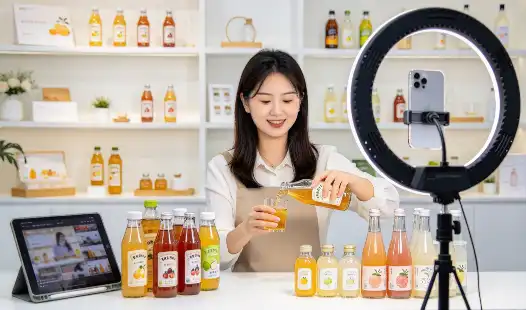
Live shopping is where a beverage can truly come alive. The host can open a can, hear the fizz, pour the drink into a clear glass, and describe the aroma. Unlike skincare or household goods, a beverage is consumed in seconds, so a live session has the advantage of showing immediate sensory satisfaction. In China social commerce, live shopping builds a public theater around the product. The audience sees the host’s reaction and simultaneously reads comments from other viewers who are receiving their own sample boxes. That parallel energy is difficult to replicate in any other channel. For a WeChat-led beverage strategy, you can schedule a live event within a WeChat mini-program or broadcast it to a closed group of confirmed buyers and interested participants.
Plan the Live Demonstration Around a Use Case
Avoid a simple product tasting. Build the live session around a specific moment of daily life. For example, a sparkling water could be introduced as a lunch drink for office workers. An energy drink could be presented in a short segment about pre-gym routines. A juice blend could be linked to breakfast preparation. The host should explain why the beverage fits that moment, what it tastes like, and whether it is sweet, sour, or lightly carbonated. This framing helps the audience imagine themselves in the scene rather than watching an abstract review.
Use the Comment Section to Correct Expectation Gaps
During a live drink tasting, the host may mention that the beverage is less sweet than a typical Chinese dairy drink. Some viewers may feel surprised. The comment section is the right place to explain that the beverage contains no added sugar and that its flavor is based on the fruit itself. This kind of open dialogue avoids the disappointment that happens when a buyer opens a bottle at home without forewarning. When your brand proactively discusses taste expectations in China social commerce, it builds a reputation for honesty.
Connect Each Live Session to a Limited WeChat Order Window
The beauty of live shopping is not that viewers buy immediately; it is that they feel motivated to respond before the end of the session. For beverages, order fulfillment is fast, so you can set a narrower window. Announce that the order for that specific batch closes at midnight, and that your team will dispatch it within three days. This creates a gentle end point without pressuring viewers into reckless behavior. The next live session can offer a different flavor or bundle size, giving returning viewers a reason to participate again.
Ready to book a live session but need a host who knows how to present beverages? Our team at info@chinaentryhub.com or +8618600291000 can introduce you to reliable hosts with product-specific knowledge.
Scale from a WeChat Pilot to a Wider Social Commerce Network
Once your beverage has completed several WeChat pilot rounds and collected a set of positive buyer comments, the natural next step is to broaden the reach. China social commerce grows most efficiently when it moves from one proven group to other groups with similar characteristics. If a group of office workers responded well to your sparkling water, find more workplace-oriented communities. If a fitness coach accepted your energy drink, approach other coaches who manage small training communities. The material you created for the original pilot—trial videos, tasting notes, comparison images—will now work in a different group. The key is to repeat the same sales model with a new host while keeping the core message consistent.
Create a Partner Manual for Group Organisers
Every group organiser who sells your beverage needs to know what it tastes like, how it is packaged, and what claims they can honestly repeat. Build a simple PDF or WeChat message with the product label, ingredient list, storage instruction, and a list of approved phrases about flavor and usage. For example, an organiser may say “a light peach tea with a hint of jasmine” but should not say “this tea will help you digest dinner.” A manual prevents accidental overstatement and makes negotiation with new partners faster.
Add Offline Events as an Extension of the Social Commerce Campaign
Beverages benefit from on-site sampling. Once your brand has a base of interest from WeChat, arrange a small tasting event with one of the group organisers or with a local distributor. Attendees can taste three flavors and then order a larger pack through the same WeChat channel. This offline-online loop strengthens loyalty and proves that the product tastes as good as it looked in the live session. A small event also gives you user-generated photos that can be shared across further campaigns.
Use an Independent Connector to Manage Partners and Compliance
At this stage, the operational burden becomes visible. A beverage brand may be talking with five group leaders across different cities. Each group has a different pace, and each partner may ask for a special price or a different packaging dimension. A foreign brand without a local office needs a connector who can coordinate between the brand and the Chinese partners. China Entry Hub works as that connector. It introduces international beverage brands to pre-screened WeChat groups, live hosts, and logistics providers, and it charges the brand directly so no other partner has a hidden interest. This alignment guarantees that advice about packaging, pricing, or promotion is designed to build the brand’s long-term value rather than to serve a distributor’s short-term margin.
If you are ready for a partner that will protect your beverage brand while building distribution, contact our specialists at info@chinaentryhub.com or call +8618600291000 and describe your current market stage.
Conclusion
Selling beverages through China social commerce and WeChat is a step-by-step process. A compliant label, a trial-ready product, a live shopping experience that demonstrates taste, and a sequence of community partners all need to be aligned. Beverages offer a strong advantage because they are repeat purchases. Once a buyer finds a drink that fits their daily habit, they become a source of free promotion. Start with one product, one group, and one city. Listen to feedback and build a manual that other partners can follow. That slow foundation turns a WeChat pilot into a reliable China sales network.
FAQ
1.Can I sell my imported beverage through WeChat before my Chinese label is ready?
No. A beverage sold inside China must have a compliant Chinese label before the first sale. If you sell through cross-border e-commerce, the label still needs to meet the requirements for imported pre-packaged foods. Completing your label before launch will save you from a refund or regulatory complication.
2.What if my beverage has a short shelf life?
A short shelf life is manageable if you use a bonded warehouse model and fast local delivery. Choose city-based pilots where the product can reach buyers within three or four days. Avoid launching in distant cities until you have confirmed the shipping time and temperature performance.
3.Should my WeChat group organiser taste the beverage before selling it?
Yes. Send a sample to every new partner and ask for an honest opinion before they start selling. A taste test gives the organiser personal confidence and helps them answer buyer questions about sweetness, carbonation, and aroma. A beverage sold without a sample creates suspicious and lazy promotion.
Start Selling Beverages in China with China Entry Hub
You now have a clear roadmap for moving a beverage brand through compliance, WeChat sales, live shopping, and community growth. The final and most important step is to connect with the right local partners. China Entry Hub can introduce your beverage to pre-screened WeChat hosts, check that your Chinese label is correct, and recommend a logistics route that matches your shelf life. Contact our bilingual specialists at info@chinaentryhub.com or call +8618600291000. Let us find a first city and a first group where your drink can be tasted, praised, and reordered through China social commerce.
The China Import and Export Industry Committee Pharmaceutical and Food Businesses The foundation of the Quality and Safety Promotion Association is an industry forum at the national level. It provides services like policy research, standards mutual recognition, regulatory compliance and customs clearance, brand globalisation, global sourcing, cross-border settlement, and legal support for the whole import-export chain of food, pharmaceuticals, cosmetics, and medical devices. The Committee enables both local and foreign businesses to reach international markets in a safe and effective manner.
References
1. Lu, B., Fan, W., & Zhou, M. (2016). Social presence, trust, and social commerce purchase intention: An empirical research. Computers in Human Behavior, 56, 225–237.
2. Hajli, N. (2015). Social commerce constructs and consumer's intention to buy. International Journal of Information Management, 35(2), 183–191.
3. Zhang, K. Z. K., & Benyoucef, M. (2016). Consumer behavior in social commerce: A literature review. Decision Support Systems, 86, 95–108.
4. Xiang, L., Zheng, X., Lee, M. K. O., & Zhao, D. (2016). Exploring consumers' impulse buying behavior on social commerce platform: The role of parasocial interaction. International Journal of Information Management, 36(3), 359–367.
5. Wongkitrungrueng, A., & Assarut, N. (2020). The role of live streaming in building consumer trust and engagement with social commerce sellers. Journal of Business Research, 117, 543–556.
6. Geng, R., Wang, S., Chen, X., Song, D., & Yu, J. (2020). Content marketing in e-commerce platforms in the internet celebrity economy. Industrial Management & Data Systems, 120(3), 464–485.
Hiker
15+ years in investment & venture building & venture building;Executive Education in Management (Peking University);International Business major;Market entry architecture & key network access
Get a Direct Response from Our China Expertise.
he challenge you're facing is one we've already solved. Leverage our proven framework to receive your custom China blueprint.